Muslim Unity
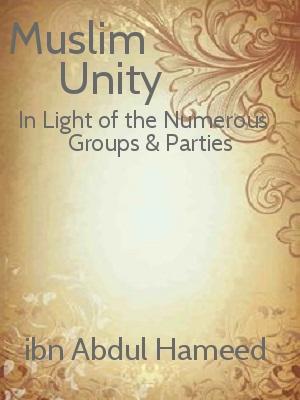
Muslim Unity
Author :
Number of volumes :
1
Publisher :
Publish number :
first
Publication year :
2004
(0 Votes)

(0 Votes)
Muslim Unity
Can Muslims maintain religious unity while disagreeing over interpretation, organization, and methods of religious work? Muslim Unity examines the causes of division within the Muslim community, paying particular attention to ignorance, injustice, factionalism, and competing religious organizations.
About the Book
Muslim Unity is attributed in the Islamic Sources catalogue to ibn Abdul Hameed. The first edition was published in 2004 as a single-volume work. The publisher is not identified.
The book addresses the unity of the ummah, the worldwide Muslim community, through a series of questions concerning disagreement and collective religious activity.
One of its central questions is whether differences among Muslims are inevitable or should be understood as problems requiring correction.
The publication identifies ignorance and ẓulm, or injustice and oppression, as important sources of wrongdoing and division.
It also examines ḥizbiyyah, commonly understood in this context as factionalism or partisan attachment within Islamic religious work.
The discussion considers how organizational loyalties may affect cooperation among Muslims.
Another subject is the relationship between religious organizations, or jamāʿāt, and the wider revival of Islamic commitment.
The book asks whether the multiplication of such groups contributes to religious renewal or creates additional divisions.
Its questions also concern the responsibilities of believers when confronted with confusion, disagreement, and harmful conduct.
A recurring concern is the effect of factionalism on younger Muslims who may struggle to reconcile competing claims of religious authority.
The publication therefore approaches unity not simply as a desirable ideal but as a practical problem involving knowledge, ethics, organizational behavior, and religious responsibility.
Its principal contribution is an examination of the internal tensions that can weaken cooperation within Muslim communities.
What You Will Discover
- Questions concerning disagreement and unity within the ummah.
- The relationship between ignorance, injustice, and division.
- The emergence of factionalism in Islamic religious work.
- The influence of religious organizations on Muslim cooperation.
- The challenges facing young Muslims amid competing group loyalties.
Who Is This Book For?
This book is suitable for students of contemporary Islamic movements, Muslim community educators, and readers interested in religious cooperation, organizational disagreements, and the ethical foundations of Muslim unity.