The Concept of Explicit Statements on Imamate in the Holy Quran
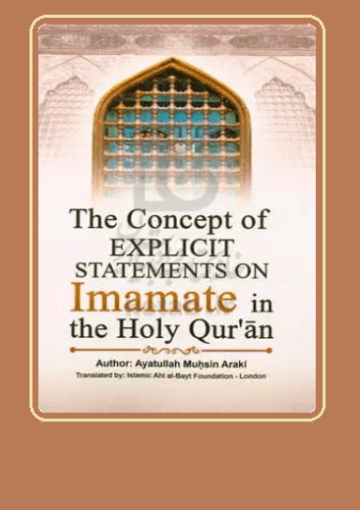
The Concept of Explicit Statements on Imamate in the Holy Quran
Author :
Interpreter :
Publisher :
Publication year :
2013
Publish number :
First
Number of volumes :
1
(0 Votes)

(0 Votes)
The Concept of Explicit Statements on Imamate in the Holy Quran
The question of religious leadership after Prophet Muḥammad occupies an important position in Islamic theology and intellectual history. Discussions of Imamate examine the nature of legitimate authority, the relationship between divine guidance and leadership, and the interpretation of Qur’anic passages considered relevant to succession.
About the Book
The Concept of Explicit Statements on Imamate in the Holy Quran addresses the theological question of whether the Qur’an contains explicit indications concerning Imamate and divinely designated religious leadership.
In Shīʿī theology, Imamate refers to the institution of authoritative guidance associated with the Imams who succeed Prophet Muḥammad.
An important concept in these discussions is naṣṣ, meaning an explicit designation or authoritative statement identifying a person for a particular religious office.
The interpretation of Qur’anic evidence concerning leadership has been discussed extensively within different Islamic theological traditions.
Shīʿī scholars have examined passages concerning authority, obedience, guardianship, and the Prophet’s family as part of arguments supporting Imamate.
Other Muslim scholars have offered different interpretations of these passages and of the relationship between scripture and political or religious succession.
The distinction between explicit textual designation and interpretation inferred from broader scriptural principles is central to this debate.
A careful examination of the subject requires attention to Arabic terminology, historical circumstances, hadith evidence, and established theological methodologies.
The topic provides an important framework for understanding the development of Islamic discussions concerning religious authority.
What You Will Discover
- The theological meaning of Imamate in Islamic thought.
- The concept of naṣṣ, or explicit religious designation.
- Qur’anic passages discussed in relation to leadership and authority.
- The relationship between scriptural interpretation and succession.
- Differences between Shīʿī and other Islamic theological perspectives.
- The role of language, history, and hadith in arguments concerning Imamate.
Who Is This Book For?
This book is suitable for Islamic theology students, researchers, historians, and readers interested in Imamate, Qur’anic interpretation, religious authority, succession, and comparative Islamic theological thought.