Imamate and Leadership
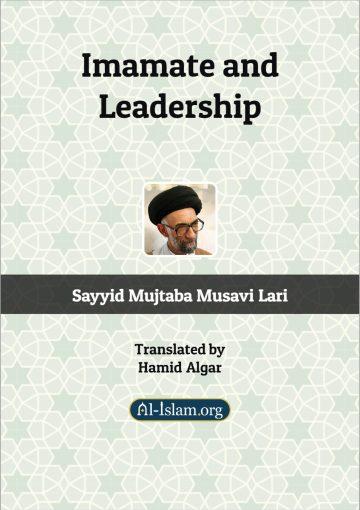
Imamate and Leadership
Author :
Interpreter :
Publisher :
Number of volumes :
1
Publish number :
first
Publication year :
2004
(0 Votes)

(0 Votes)
Imamate and Leadership
The question of rightful succession within the Muslim community after the Prophet (peace be upon him and his Family) stands as one of the most profound theological inquiries in Islamic thought. Imamate and Leadership presents a rigorous study of this question, portraying the doctrine of divinely guided authority as the foundation of Shīʿī theology and the continuation of the Prophet’s divine mission.
About the Book Imamate and Leadership examines the intellectual, scriptural, and historical foundations of the doctrine of Imamate—the divinely designated succession to the Prophet (peace be upon him and his Family). Through rational reasoning and Qurʾānic analysis, the book establishes that Imamate is not a political construct but a theological necessity ensuring the preservation of revelation and moral integrity under divinely appointed guidance. The author contrasts this divinely ordained model with systems of leadership based on consultation (shūrā), demonstrating how revelation mandates continuity through chosen guides.
What You Will Discover
- The distinction between Imamate (divine leadership) and caliphate (political authority).
- Qurʾānic and hadith (prophetic tradition) proofs for the divine appointment of the Imams (ʿa).
- Philosophical arguments establishing the necessity of continuous divine guidance.
- The Prophet’s (peace be upon him and his Family) designation of Imam ʿAlī (ʿa) as his successor.
- The attributes required of a divinely appointed leader.
- Comparative analysis of Sunni and Shīʿī perspectives on succession.
- The implications of Imamate for governance, ethics, and spiritual unity.
About the Author The book is authored by ʿAllāmah Sayyid Muḥammad Bāqir al-Ṣadr (1935–1980), one of the most distinguished modern Shīʿī theologians and philosophers. Renowned for his analytical method and depth of insight, al-Ṣadr combines philosophical reasoning with Qurʾānic exegesis to clarify the theological foundations of divine leadership in Islam. His writings—spanning theology, jurisprudence, and socio-political thought—remain central to contemporary Shīʿī scholarship.
Who Is This Book For? This book is for students and scholars of Islamic theology, researchers of Qurʾānic and philosophical thought, and readers seeking a lucid and reasoned presentation of the Shīʿī doctrine of Imamate.