Annals of the early Caliphate
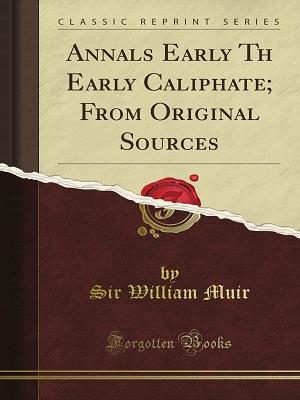
Annals of the early Caliphate
Author :
Publication year :
1883
Publisher :
Publish number :
fIRST
Number of volumes :
1
(0 Votes)

(0 Votes)
Annals of the early Caliphate
The decades following the death of Prophet Muḥammad witnessed profound political, military, and religious transformations. The Muslim community expanded beyond Arabia, developed new institutions of government, and confronted disputes over leadership. William Muir's historical account examines these developments through the lens of nineteenth-century scholarship.
About the Book
Annals of the early Caliphate by William Muir is a historical study of the early Muslim caliphate, originally published in 1883.
The catalogue identifies Forgotten Books as the publisher associated with the listed edition.
Muir conceived the work as a continuation of his earlier Life of Mahomet. Beginning with the Prophet's death and burial in 632 CE, the book follows the subsequent development and expansion of the Muslim community.
Its central concern is the emergence of the caliphate and the factors that contributed to the rapid spread of Islamic rule.
The author examines national, tribal, and religious influences that shaped the early Muslim polity.
This combination of factors is significant because the expansion of the caliphate cannot be understood solely through military campaigns.
Political leadership, tribal alliances, religious commitment, and the administration of newly incorporated territories all contributed to the historical transformation of the region.
Muir's work belongs to a period when European scholars increasingly produced extensive historical narratives based on Arabic chronicles and other available sources.
His account is therefore valuable not only for its historical subject but also as an example of nineteenth-century Western scholarship on Islam.
However, Muir wrote within the intellectual and imperial context of his time. His interpretations, terminology, and evaluations should be examined critically, particularly where they concern Muslim religious beliefs or disputed historical events.
The book should not be treated as a substitute for contemporary historical scholarship or for direct engagement with early Islamic sources.
Its principal contribution is a sustained narrative of the formative caliphate and the forces that shaped its development.
What You Will Discover
- Events following the death of Prophet Muḥammad.
- The emergence and development of the early caliphate.
- Political and tribal factors affecting Muslim leadership.
- The expansion of Islamic rule beyond Arabia.
- Religious influences on the early Muslim community.
- A nineteenth-century interpretation of formative Islamic history.
Who Is This Book For?
This book is suitable for students of early Islamic history, researchers examining the development of the caliphate, and historians of Western scholarship on Islam. It is particularly valuable when read critically alongside modern studies and early Arabic historical sources.