Second coming of Jesus Christ A Comparision Between Islamic and Qadiani Views
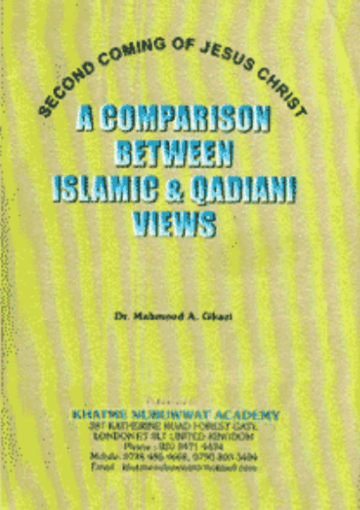
Second coming of Jesus Christ A Comparision Between Islamic and Qadiani Views
Author :
Publisher :
Publish number :
First
Publication year :
2015
Publish location :
London - United Kingdom
Number of volumes :
1
(0 Votes)

(0 Votes)
Second coming of Jesus Christ A Comparision Between Islamic and Qadiani Views
Will Jesus return before the Day of Judgment, and why do Muslim communities disagree about the meaning of this expectation? Second coming of Jesus Christ A Comparision Between Islamic and Qadiani Views examines the controversy between mainstream Sunni interpretations and Ahmadiyya understandings of Jesus' return.
About the Book
Second coming of Jesus Christ A Comparision Between Islamic and Qadiani Views is attributed in the Islamic Sources catalogue to Mahood A. Ghazi, identified in its description as Shaykh Dr. Mehmood Ahmad Ghazi.
The first edition was published by Khatme Nubuwwat Academy in London, United Kingdom, in 2015.
The publication addresses the doctrine of the second coming of Jesus, a subject associated with Islamic eschatology and the events preceding the Last Day.
Its central purpose is to compare what the author describes as the Islamic position with the interpretation associated with the Qadiani movement.
The term Qadiani is commonly used in polemical discussions of the Ahmadiyya movement, whose members generally prefer the designation Ahmadi Muslims.
Mainstream Sunni and Twelver Shīʿī traditions affirm the future return of Jesus, although details of their eschatological interpretations differ.
Ahmadiyya theology offers a different understanding of Jesus' fate and the fulfillment of prophecies concerning his return.
These disagreements also intersect with debates about the finality of prophethood and the religious claims associated with Mirza Ghulam Ahmad.
The catalogue explicitly describes the book as a rejection of Qadiani beliefs, establishing its polemical rather than neutral comparative orientation.
Its arguments should therefore be understood as representing the author's theological position, not an impartial statement of every community's beliefs.
The available description does not identify the individual Qurʾānic passages or Prophetic traditions examined.
Nevertheless, the publication's central concern is clear: the second coming of Jesus as a disputed doctrine within modern Islamic theological debate.
What You Will Discover
- The doctrine of Jesus' second coming in Islamic eschatology.
- Differences between mainstream Muslim and Ahmadiyya interpretations.
- The relationship between Jesus' return and questions of prophethood.
- The author's criticism of Qadiani theological claims.
- A comparative controversy concerning scriptural interpretation.
Who Is This Book For?
This book is suitable for students of Islamic eschatology, researchers in modern Muslim theological movements, and readers interested in debates between mainstream Islamic and Ahmadiyya interpretations of Jesus' return.