The Musalman
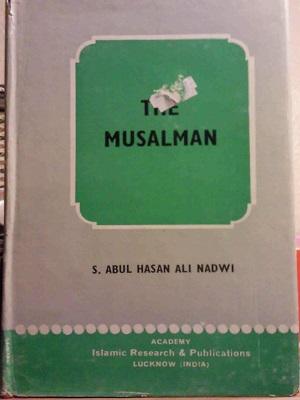
The Musalman
Author :
Interpreter :
Publisher :
Publication year :
1977
Publish number :
Second
Publish location :
India
Number of volumes :
1
(0 Votes)

(0 Votes)
The Musalman
What does it mean to be a Muslim in a society where people of different religions have lived alongside one another for centuries? The Musalman approaches Muslim identity through the social realities of India, where Hindu and Muslim communities share neighborhoods, workplaces, educational institutions, and everyday responsibilities.
About the Book
The Musalman was written by Abul Hasan Ali Hasani Nadwi and translated by Mohiuddin Ahmad. The second edition was published by Islamic Research and Publications in India in 1977.
The book's introduction begins with the longstanding relationship between Hindus and Muslims in the Indian subcontinent.
Nadwi observes that the two communities have lived alongside one another for approximately a thousand years, developing relationships extending beyond geographical proximity.
In towns, villages, and cities, members of both communities have participated in shared economic and social environments.
They have been neighbors, colleagues, business partners, and participants in educational and professional institutions.
This historical setting provides an important background for examining Muslim identity.
Religious belonging does not exist in isolation from everyday relationships. Muslims living in a religiously diverse society encounter questions about their distinctive beliefs, social responsibilities, and interactions with other communities.
The title's use of Musalman, a familiar South Asian designation for a Muslim, also places the work within the linguistic and cultural context of the subcontinent.
Nadwi was an influential Muslim scholar whose writings frequently addressed Islamic religious life and the challenges facing Muslim societies.
However, the available catalogue excerpt establishes only the book's opening discussion of Hindu-Muslim coexistence. It does not identify the subsequent chapters or the author's detailed conclusions.
The publication should therefore be introduced through its confirmed social and religious setting rather than through unverified claims about its treatment of particular controversies.
Its opening perspective invites reflection on the experience of being Muslim within a society characterized by longstanding religious diversity.
What You Will Discover
- The historical coexistence of Hindus and Muslims in India.
- Shared social and economic relationships between religious communities.
- The South Asian context of Muslim religious identity.
- The relationship between religious belonging and everyday social life.
- A perspective associated with Abul Hasan Ali Hasani Nadwi.
Who Is This Book For?
This book is suitable for students of South Asian Islam, researchers in Hindu-Muslim relations, and readers interested in Muslim identity and religious life within culturally and religiously diverse societies.