Appreciation and Interpretation of Religion in the Modern Age
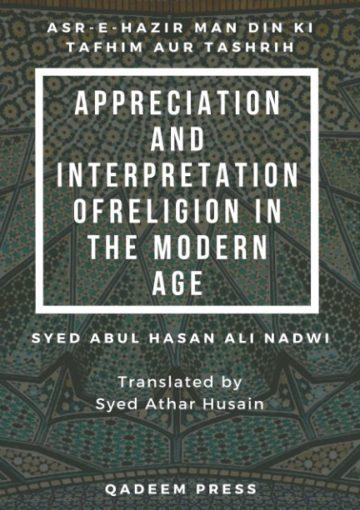
Appreciation and Interpretation of Religion in the Modern Age
Author :
Interpreter :
Publisher :
Publication year :
1982
Publish location :
India
Publish number :
First
Number of volumes :
1
(0 Votes)

(0 Votes)
Appreciation and Interpretation of Religion in the Modern Age
What is the ultimate purpose of religious activity, and how should Muslims distinguish spiritual objectives from organizational or political means? Appreciation and Interpretation of Religion in the Modern Age examines the relationship between devotion to Allah, religious institutions, and the pursuit of social reform.
About the Book
Appreciation and Interpretation of Religion in the Modern Age was written by Abul Hasan Ali Hasani Nadwi. The Islamic Sources catalogue credits Syed Athar Husain Rizvi in its translation-related metadata and records a first edition published by the Academy of Islamic Research and Publications in India in 1982.
The book's introductory statement establishes a clear distinction between the ultimate objectives of religious life and the methods employed to pursue them.
According to Nadwi, the fundamental purpose of human existence is to seek Allah's pleasure, follow the Qurʾān and Prophetic Sunnah, and attain salvation in the Hereafter.
Religious organizations, political leadership, social reform, and governmental activity are presented as means rather than ultimate ends.
This distinction is central to the publication's message.
Nadwi argues that religious commitment should not be reduced to loyalty toward particular personalities, organizations, or political movements.
Instead, involvement in these activities should be motivated by sincere dedication to religious principles.
The author also warns against partisan attachment that displaces spiritual purpose.
This argument is especially relevant to discussions of Islamic activism and the relationship between religious ideals and institutional activity.
The publication does not reject organization or social reform in its introductory statement. Rather, it emphasizes that such efforts must remain subordinate to higher religious objectives.
The catalogue does not provide a complete chapter outline or identify the individual contemporary movements examined.
Its confirmed contribution is a reflection on religious priorities, spiritual intention, and the proper relationship between ultimate goals and practical methods.
The work offers a perspective on how Muslims may evaluate religious activity without confusing institutional success with spiritual achievement.
What You Will Discover
- Nadwi's understanding of the ultimate purpose of religious life.
- The importance of seeking Allah's pleasure and salvation.
- The distinction between religious objectives and organizational methods.
- The relationship between spiritual commitment and social reform.
- Criticism of excessive attachment to personalities and organizations.
- The importance of sincerity over partisan loyalty.
Who Is This Book For?
This book is suitable for students of Islamic ethics, researchers in Islamic revival movements, religious educators, and readers interested in the relationship between spirituality, activism, and institutional leadership.