Islam in a Changing World
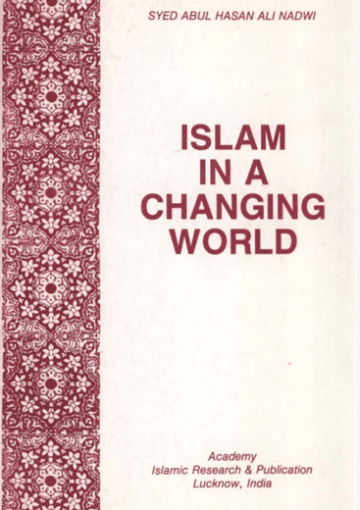
Islam in a Changing World
Author :
Scholar :
Publisher :
Publish location :
Lucknow - India
Publish number :
first
Publication year :
2011
Number of volumes :
1
(0 Votes)

(0 Votes)
Islam in a Changing World
How can Muslim scholars and educational institutions address religious questions during periods of social and intellectual change? Islam in a Changing World introduces material associated with a major gathering of Muslim scholars and institutional leaders in India, offering a historical perspective on Islamic intellectual exchange.
About the Book
Islam in a Changing World was written by Abul Hasan Ali Hasani Nadwi. The Islamic Sources catalogue records a first edition published by the Academy of Islamic Research & Publications in Lucknow, India, in 2011.
The publication's description refers to a gathering held in January 1977 under the auspices of the Department of Islamic Studies at Aligarh Muslim University.
Scholars from different parts of India attended the event, alongside leaders of several prominent Muslim institutions.
The catalogue identifies Professor A. M. Khusro, Vice-Chancellor of Aligarh Muslim University; Maulana Qari Muhammad Tayyab, head of Darul Uloom Deoband; Maulana Abul Hasan Ali Nadwi, associated with Nadwatul Ulama in Lucknow; and Dr. Masud Husain Khan, Vice-Chancellor of Jamia Millia in Delhi.
Their participation demonstrates the institutional breadth of the gathering.
The involvement of universities and traditional religious educational establishments is particularly noteworthy.
These institutions represented different settings for Islamic learning and intellectual activity within Indian Muslim society.
The title places the publication within discussions of Islam and a changing world.
However, the catalogue does not identify the event's precise agenda, the individual papers delivered, or the conclusions reached by participants.
It would therefore be inappropriate to reconstruct specific debates concerning secularism, modernization, or educational reform without further evidence.
The publication's confirmed historical context is the 1977 scholarly gathering and the participation of prominent Muslim educational leaders.
Its value lies in documenting an intellectual setting in which representatives of important Islamic institutions came together during a period of social change.
What You Will Discover
- The historical setting of a Muslim scholarly gathering in January 1977.
- The involvement of Aligarh Muslim University.
- Participation by leaders of major Indian Muslim institutions.
- The relationship between traditional religious institutions and universities.
- A historical context for examining Islamic intellectual activity in modern India.
Who Is This Book For?
This book is suitable for researchers in South Asian Islamic history, students of Muslim educational institutions, and readers interested in scholarly exchanges concerning Islam in the modern world.